 A schematic design of a basic living unit for the researchers. It is three stories high allowing for as much space as possible. The units are connected through a central "green space" or a recreation area. The separate buildings are also tied together through intricate webs of tensile fabric. Although in the drawing the units are subterranean, our idea has changed to entirely above ground. Public hydroponics will most likely be located in the "green space" area. The design is comprised entirely of our interlocking modules.
30.1.08
Schematic Design of Lunar Living
A schematic design of a basic living unit for the researchers. It is three stories high allowing for as much space as possible. The units are connected through a central "green space" or a recreation area. The separate buildings are also tied together through intricate webs of tensile fabric. Although in the drawing the units are subterranean, our idea has changed to entirely above ground. Public hydroponics will most likely be located in the "green space" area. The design is comprised entirely of our interlocking modules.
Lunar Chair Design
We designed a chair using our two basic modules. As you can see, there are several materials, foam, plastic, wood, and metal, demonstrating the different textures and uses of each module. We propose that octahedron is the structural member and the cube is the infill. The cube will change materials depending on its use within the lunar environment.
We designed a chair using our two basic modules. As you can see, there are several materials, foam, plastic, wood, and metal, demonstrating the different textures and uses of each module. We propose that octahedron is the structural member and the cube is the infill. The cube will change materials depending on its use within the lunar environment.


25.1.08
Modular Infrastructures...
Thus far in the development, we have decided to allow our skeletel octahedron to become the infrustructure of the entire development. They are assumed to be a strong, more dense, more robust material that would serve as structural support and the means for air, electrical, and plumbing transfer from one space to another.
We've embarked on a new prototype which attempts to employ a system of tubes at the outer edges of the main structural devices (octahedron). These tubes would serve as transport devices for air and water and would also allow for smaller mechanical and electrical wires to be run through in a neat and orderly manner.


With more details currently being developed, this preliminary infrastructural prototype rendering shows how the octahedron come together and essentially form long tunnels that will run the entire length of the room and eventually, the entire Colony.
23.1.08
Modular Prototype
Our modular prototype assignment was to develop a chair (rather, a general seating device) using scaled protypes of our modules. The development of our chair was a very important step in the process of understanding the constructability of our modules. During the construction of our chair, we took into consideration the development of a palette for future modular development. Our palette attempts to accomplish distinguishable changes in color, texture, strength, density, and other aspects. In the chair prototype we distinguished between the structural aspects through changes in color and we distinguished differences in texture by using a softer more comfortable material.
****Pictures Pending****
21.1.08

19.1.08
Modular Wall
This rendering is the expected outcome of the modular robots configuring themselves into a wall of sorts. This is the preliminary basis of all structural aspects of the Lunar Colony...

We are continuing to develop structural and architectural devices for the lunar colony as well as infrastructural details that will exist in the colony.

Rendering of full scale wall compared to human scale.

Example of interchangable LED light module. Exterior walls are completely solid [with the exception of window openings] - during the days of complete darkness in the Lunar Colony - Inhabitants can interchange insulating cube modules with LED light modules.
18.1.08
Preliminary Animation
A small animation (i realize it's terrible - its just for now until i can learn the software more adequately) to show how the panels will form into cubes and eventually stack themselves.
When one panel forms itself into a cube using magnetic forces, the top flap of the cube flips off and reaches over to the neighboring cube. Using magnets, the second cube is then flipped over onto the top of the first. Additional cubes will then be able to crawl up the side of the developing "wall" using the same magnetic forces and begin to form structure.
We are currently still developing how the skeletal octohedron will put themselves into place amongst the rest of the modules. (we assume it will probably work in a similar manner.)
***Currently working on animation of complete assembly***
16.1.08
Module MADNESS
viral module: how it creates itself
Team

viral module: how it Moves along the moon
As seen in the animation, a few squares are connected so they created a “moving caterpillar” type module. With this system each square can inch its way, using magnetic forces and robotics, to a designated location within the dome and then start recreating itself. We propose that the squares lay flat on top of one another and then begin production starting from the bottom up. The cube caterpillar will follow each octahedron caterpillar and then begin the process of recreation. viral module: unresolved ideas
- We are currently toiling with the idea that once the octahedrons are created they can easily latch onto the cube through an interlocking, sliding track system or some variation of this.
- One idea is to create a “male” track in the 90 degree angle of the octahedron and a “female” slider that fits into the track through sliding along the outer edges of the cube.
- Another idea, although more difficult, was to diagonally cut a few planes of the cubes so that only triangles remain; those triangles would then somehow slot or interlock with the triangles from the decahedron so form a new square plane.
- We are not sure on how the octahedron and the cube come together as they begin recreating themselves from the caterpillar form.
- One obvious idea is through magnetism, maybe the points of the octahedron connect with magnetism to create a very open wall, then the cubes inches its way up the wall, finds its place, folds to create itself, and then fits easily within the voids of the octahedrons.
15.1.08
14.1.08
Modular Systems
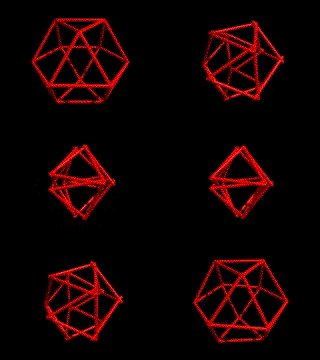
We are currently embarking upon the very complex process of creating a system of modular robotics which will eventually be used for structural development of the Lunar Colony.
Preliminary modular system :


This portion of the module would be manufactured in two pieces as flat panels. It would fold itself into the desired shape and then come together with an exact copy to create a skeletal form of an Octeherdon. In combination with panels folding to create cubes, a variety of forms can be created.


Currently, we are exploring the possibilities of panels being able to create and store themselves flat and then fold themselves into all three dimensional objects.
Further experimentation pending.
9.1.08
Adrianna's Images
Images (in order):
1. Stephan Martiniere "Angel City" used as cover art for Hitting the Skids in Pixeltown 2. Don Dixon "Crucible" 3. Les Edwards "Cygnus" 4. John Berkey unknown title 5. Stephan Martiniere "Anarchite City" concept artwork for Legends of the Underground 6. Stephan Martiniere "The Risen Empire" used as cover art for Succession 7. (just for fun) Tim Hildebrant


Haley's Images
Images (in order):
1. By Artist Frank R. Paul 2. By Artist John Berkey 3. By Unknown Artist
4. By Artist James Clyne
5 & 6. By Artist Ryan Church


Subscribe to:
Posts (Atom)
