This image is Lunar Chart: CLAVIUS LAC 126. It is located close to the south pole of the moon for purposes of providing optimal sunlight. [see picture below for close-up]
 As you can see from the location chart, the location of the crater is in section 126 which is in the South-East direction of the South pole region of the moon.
 Choosing an appropriately sized crater was left up to us as a group and after studying a few groups of craters [attempting to find a proper one as far south as possible], we decided upon Lunar Crater Lilius.
 This image shows Lunar Crater "Lilius P" which is a satellite crater of the much larger Lilius. "Lilius P" is located at LATITUDE: 55.9 degrees S LONGITUDE 3.9 degrees E. "Lilius P" is 4km in diameter which is almost exactly 2.5 miles in diameter.


 [housing example]
Some more sketches representing ideas we have about the colony design and details...
 Additional housing concept


A beginning view of the dome and the very preliminary organizational elements of the dome such as docking/berthing portions for shuttle arrival and departure; general hydroponics areas, methods for emergency evacuation, subterranean factories and fabrication of modules [not mining as pictured], and also a general view of proposed platforms. 
Proposed platforms and establishing a more three-dimensional view of the city.

Preliminary spatial diagram of proposed architecture within the dome - used as conceptual model for housing and other public buildings in the colony.
Working on specific details and further establishing permanant master plan.


 A schematic design of a basic living unit for the researchers. It is three stories high allowing for as much space as possible. The units are connected through a central "green space" or a recreation area. The separate buildings are also tied together through intricate webs of tensile fabric. Although in the drawing the units are subterranean, our idea has changed to entirely above ground. Public hydroponics will most likely be located in the "green space" area. The design is comprised entirely of our interlocking modules.


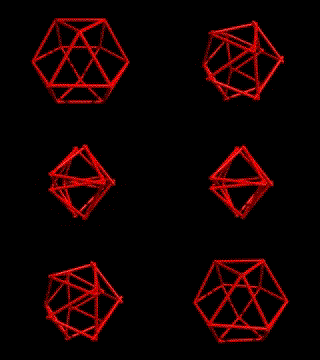
With more details currently being developed, this preliminary infrastructural prototype rendering shows how the octahedron come together and essentially form long tunnels that will run the entire length of the room and eventually, the entire Colony.

We are continuing to develop structural and architectural devices for the lunar colony as well as infrastructural details that will exist in the colony.

Rendering of full scale wall compared to human scale.

Example of interchangable LED light module. Exterior walls are completely solid [with the exception of window openings] - during the days of complete darkness in the Lunar Colony - Inhabitants can interchange insulating cube modules with LED light modules.
A small animation (i realize it's terrible - its just for now until i can learn the software more adequately) to show how the panels will form into cubes and eventually stack themselves.
When one panel forms itself into a cube using magnetic forces, the top flap of the cube flips off and reaches over to the neighboring cube. Using magnets, the second cube is then flipped over onto the top of the first. Additional cubes will then be able to crawl up the side of the developing "wall" using the same magnetic forces and begin to form structure.
We are currently still developing how the skeletal octohedron will put themselves into place amongst the rest of the modules. (we assume it will probably work in a similar manner.)
***Currently working on animation of complete assembly***
viral module: how it creates itself
Team

viral module: how it Moves along the moon
As seen in the animation, a few squares are connected so they created a “moving caterpillar” type module. With this system each square can inch its way, using magnetic forces and robotics, to a designated location within the dome and then start recreating itself. We propose that the squares lay flat on top of one another and then begin production starting from the bottom up. The cube caterpillar will follow each octahedron caterpillar and then begin the process of recreation. viral module: unresolved ideas


Currently, we are exploring the possibilities of panels being able to create and store themselves flat and then fold themselves into all three dimensional objects.